Early access

One file per boat

The manual your boat never came with.

Every boat arrives with a carrier bag of manufacturer handbooks and nothing at all about your boat. Which seacock is behind which panel. Where the bilge pump cable actually runs. What the last owner changed, and when.

Both open a demonstration boat. It is fictitious — invented equipment, invented history — built to show what a completely documented boat looks like.

The problem

That knowledge lives in one person's head, and it leaves with them.

A boat that has been owned for fifteen years is full of decisions nobody wrote down. The previous owner knew which valve was stiff and which gauge lied. Some of it was said at the handover, most of it wasn't, and none of it was written down.

So you rediscover it slowly, usually at the worst moment — the alarm sounding on the way into the harbour entrance, the water in the bilge you can't account for.

Things worth knowing before you need them

  • Which of the eleven seacocks is the engine intake, and whether its handle still turns
  • Whether the bilge pump is on its own fuse, so it still works with the panel off
  • What size cable feeds the windlass, and where its fuse actually is
  • When the saildrive diaphragm was last changed — a seven-year item
  • Whether the tank gauge is broken, or has simply never been calibrated

What it is

A technical handbook written for one boat: yours.

Not a folder of PDFs. A living record of what is aboard, where it sits, what it connects to, and what has been done to it — that opens on a phone at the pontoon with no signal.

01

A map of your boat, in three layers

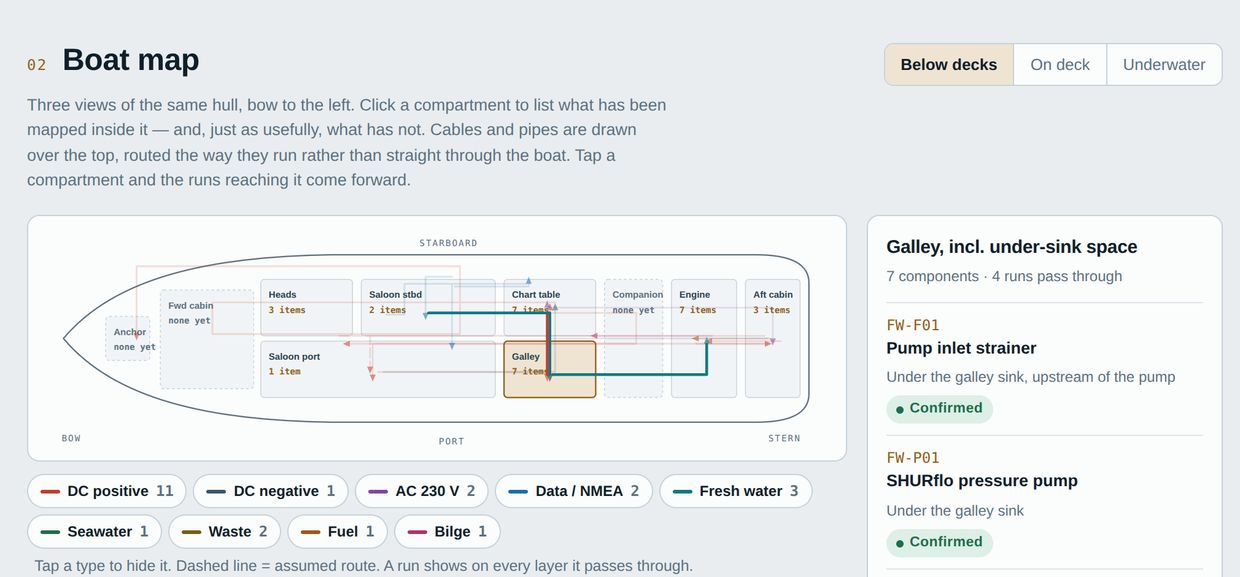
Below decks, on deck, and underwater. Tap a compartment to see what has been recorded in it — and, just as usefully, what has not. Nothing recorded yet shows as a dashed outline, so the gaps are the to-do list.

Every component carries a code like FW-P01, so a photograph or a note can point at exactly one thing.

A plan of a yacht with compartments, showing cable and pipe runs drawn over it

02

Wiring and plumbing you never have to draw

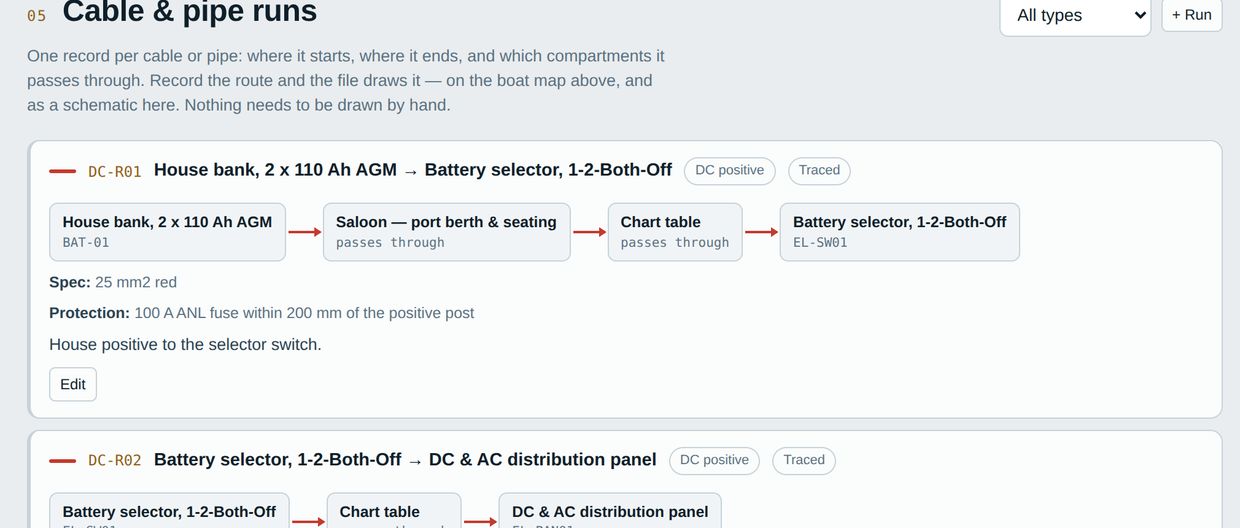
Record a run as plain facts — from the house bank, through the port saloon and the chart table, to the DC panel, 25mm² red, 100A fuse at the battery. The route draws itself on the boat map and again as a clean schematic.

Nine kinds of run, each its own colour: DC positive and negative, mains, data, fresh water, seawater, waste, fuel and bilge.

A cable run shown as a schematic from battery to distribution panel

03

Every hole in the boat, and whether its valve turns

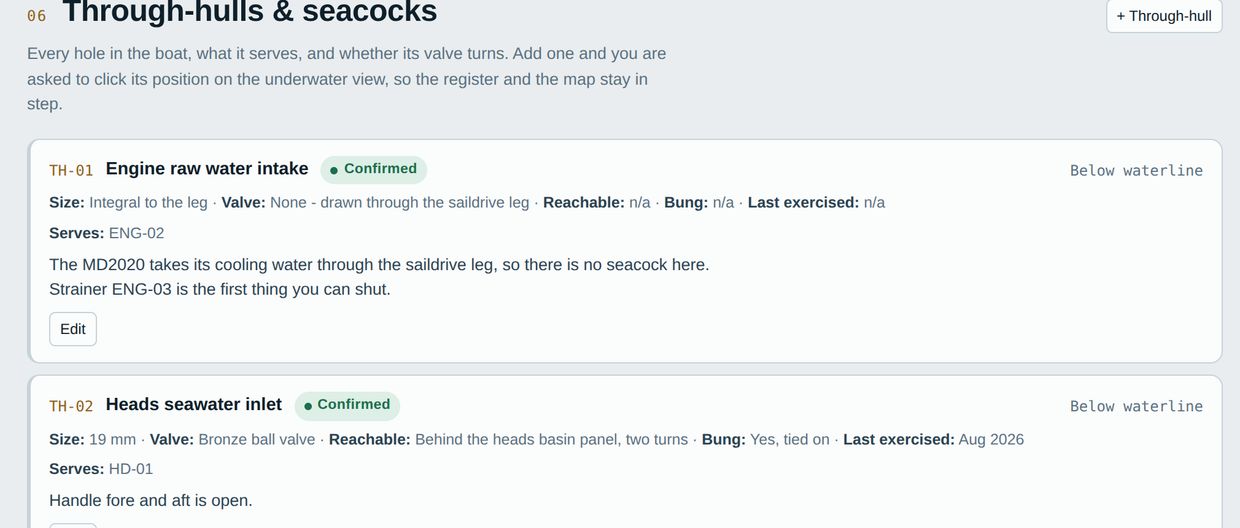
Size, valve type, which side of the waterline, whether you can reach it in a hurry, whether a softwood bung is tied to it, and when it was last exercised. Add one and you click its position on the hull, so the register and the map agree.

The section most owners say they'd want first, and the one nobody has.

A register of through-hull fittings and seacocks with sizes and service dates

04

A 360 walk-through that knows what it's looking at

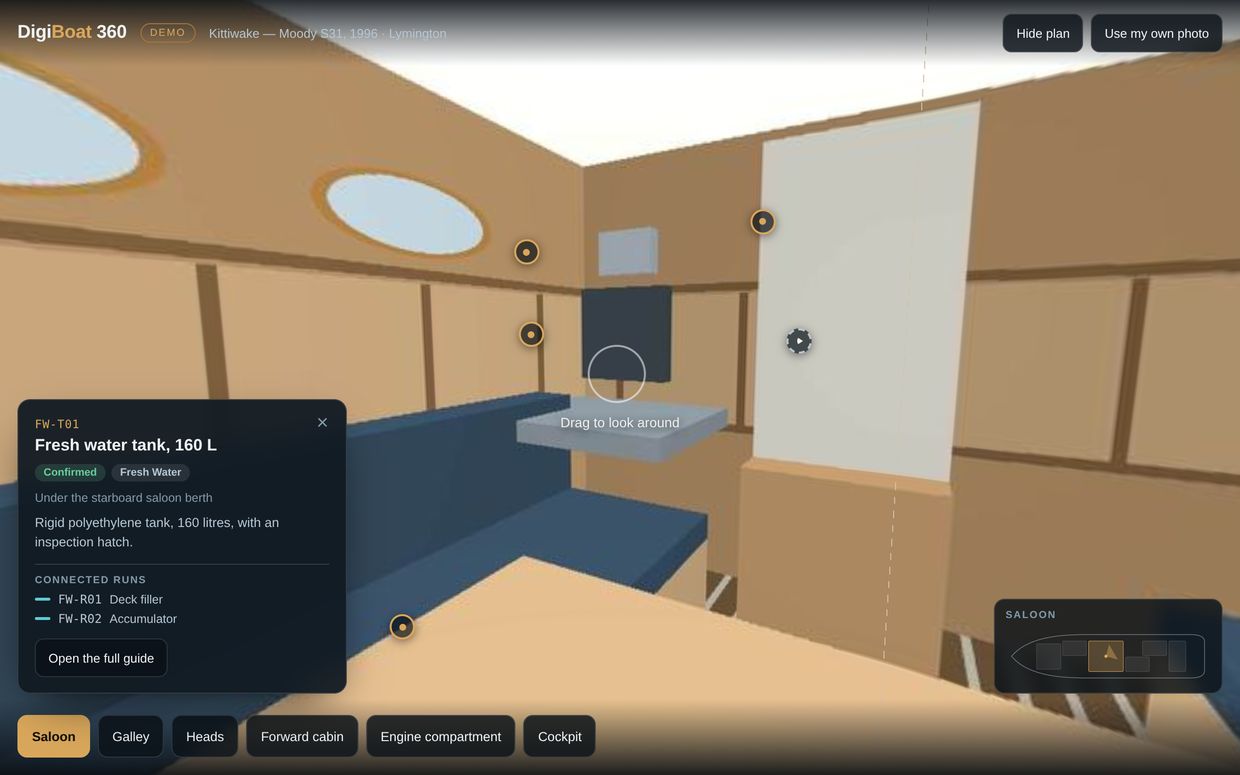
Stand in the galley and look around. The markers aren't captions — tap the pump under the sink and you get its record, its specification and the cables and pipes connected to it. The picture and the paperwork are the same thing.

Shoot the panoramas on a phone or a 360 camera. Nothing to draw.

A 360 view of a yacht interior with a component record open beside it

Why it earns its keep

“Temperature alarm at 2,000 rpm off the entrance. Stopped, sailed clear, opened the strainer and found a fist of weed. Cleared it and the temperature came straight back down. Ten minutes, because we knew where the strainer was.”

A log entry from the demonstration boat. Ten minutes is the whole argument: the difference between a documented boat and an undocumented one is rarely the repair. It's the twenty minutes of looking first.

Three things that matter

Built the way a boat's papers should work.

It says what it doesn't know

Every entry is marked Confirmed, Probable, Reported or Fault. It stops “the previous owner said the gauge doesn't work” quietly becoming “the sender is broken” three months later.

It works with no signal

One self-contained file. It opens from your phone in a boatyard with no bars, and it doesn't stop working because a subscription lapsed.

It goes with the boat

When you sell, you hand it over intact — which is worth something to a buyer, and rather more than the carrier bag of manuals you were given.

Where this is up to

Early, and looking for boat owners to argue with it.

This is being built by an owner documenting his own boat, a 1997 Moody. It is not a finished product and there is nothing to buy. What would help most right now is hearing what you'd actually want to look up, standing in your cockpit in the rain.

Used only to get back in touch about DigiBoat. No list, no newsletter, no passing it on. Or just email hello@digiboat.co.uk.